Tuesday, March 2, 2010

My Sun Doesn't Rise


Light heralds day, signifying that the night is ending. 
We see the world brighten gradually.  
The sun appears to us as creeping above the horizon in the east.  
But it doesn't really rise.  
It only appears that way.  
It's me that's coming into the sun's view while standing on this spot on the earth.  
Why don't we call it "earth spin" instead of "sunrise"?  
Depending on where we are located, we are moving between 500-700 miles per hour spinning eastward. 
It doesn't feel that way because everything else is moving with us.  But, if the earth were to stop spinning, the atmosphere would continue moving around at about 1,000 miles per hour. Dr. Sten Odenwald tells us that, "as a result, everything not attached to bedrock would pretty much be scoured clean".  
He doesn't believe that this could happen.  
But, he does tell us that it is possible for the earth to slow down gradually.
He says:
"If the process happened gradually over billions of years, the situation would be very different, and it is this possibility which is the most likely as the constant torquing of the Sun and Moon upon the Earth finally reaches it's conclusion. If the rotation period slowed to 1 rotation every 365 days a condition called 'sun synchronous', every spot in the Earth would have permanent daytime or nighttime all year long. This is similar to the situation on the Moon where for 2 weeks the front-side is illuminated by the Sun, and for 2 weeks the back side is illuminated. This situation for the Earth is not the condition of 'stopped' rotation, but it is as close as the laws of physics will let the Earth get." 
 So, earth's spin causes daylight.  
I think we may run the risk of misunderstanding what's actually happening if we don't stop to think about it.  There's a lot more to it, but this is enough for now.

I enjoy seeing the sun when it appears in the morning; it's good to know that it's still out there 93 million miles away doing it's job.

Monday, March 1, 2010

Of Windows and Light

 
Look deep into my eye. 
You are getting very thirsty, no?
Sleepy?
Itchy?
Board with my weirdness?
Well, this is a place to publish musings, so a musing I shall go. 
Just for a while.
Our eyes are amazing and very complex machines. 
Tonight, I'm interested in just a few ideas regarding them.


What are they?
If we live by metaphors, then perhaps they are containers for emotions. Giving examples of word usage to illustrate what eyes might truly mean to us, George Lakoff and Mark Johnson shed light on how we view them: "I could see the fear in his eyes. His eyes were filled with anger. There was passion in her eyes. His eyes displayed his compassion. Love showed in his eyes. Her eyes welled with emotion." (103)
What is 'in' yours?
Or, are they instead windows to your soul? 
As expressive as they can be, I believe you can learn a great deal by looking at them. However, if you look too deeply, the only thing you might learn is how irritated a person can become by being stared at.  
Also, as a warning, vicious dogs will most likely believe you are hostile and attack you if you try to look into their windows deeply (The Dog Whisperer website).

Can we see without them?
Strangely, yes.
“Our findings revealed that blind persons, including those blind from birth, do report classic Near Death Experiences (NDEs) of the kind common to sighted persons; that the great preponderance of blind persons claim to see during NDEs and Out of Body Experiences; and that occasionally claims of visually-based knowledge that could not have been obtained by normal means can be independently corroborated."  
Light exists even if we don't see it, and apparently our sight exists even if we can't use it bodily.  
Interesting to consider.  
Too deep for the moment.  
Let me refocus.

Are there aliens floating in mine?
Maybe.  "Eye floaters" are deposits or condensation in the vitreous jelly of the eye. People use the term eye floaters to describe seeing floating spots within their vision when they look around. Eye floaters may be present in only one eye or both eyes."  I like to think of these little floaties as allies for some purpose.  When in meetings or other moments when whimsy beckons, I admit to making them dance and slide around to my own choreographed imaginings.  My own placid coup.


Not Quite Academic Notes:
Lakoff, George and Mark Johnson. "Metaphors We Live By." Illinois: University Of Chicago Press, 103
Medicine.net.  2010. Medicine.net, Inc.
 
Ring, Kenneth Ph.D. and Sharon Cooper, M.A. "Near-Death and Out-of-Body Experiences in the Blind: A Study of Apparent Eyeless Vision." Journal of Near-Death Studies, 1997: 1

The Dog Whisperer. 2005.


Friday, October 2, 2009

Brief Findings on the Classical Guitar and Why it Moves Me

“Music is the medium through which we express our feelingsof joy and, sorrow, love and patriotism, penitence and praise.It is the charm of the soul, the instrument that lifts the mind tohigher regions, the gateway into the realms of imagination. Itmakes the eye to sparkle, the pulse to beat more quickly. Itcauses emotions to pass over our being like waves over the far-reaching sea.” (Carl E. Seashore 1938)

The instrument known as the classical guitar gives musicians and listeners something not found in other instruments. While it’s true that every instrument has offerings and peculiarities that separate each from the others, no other instrument can accomplish as much, as well and as simply as the classical guitar. History will be a guide in revealing and examining what those qualities are that draw so many, including myself, to this beautiful instrument.

Although there is a great deal of debate regarding the first historical evidence of a guitar-like instrument, it is widely believed that such a device was used as early as 1900 years before the birth of Jesus Christ, as appearing in drawings on clay plaques in what has been referred to as the “Cradle of Civilization” or Assyria and other nations within that region. The significance of this to me is in the concept that some principles of expression are timeless, indeed eternal.

The beginnings of the guitar usually focus upon the “lute” and other like instruments; lutes of many different kinds being widely used across early European nations, through the Middle East, and also Asia. The true origin of the word “guitar” is based on the Greek work “kithara” which was actually a lyre and did not in any way resemble the lute.

In early Egypt, versions of this instrument developed to include clearly marked frets. This seemingly small change probably increased the playability of the instrument a great deal. For contrast, one could be invited to experiment with the violin, which does not have clearly marked frets and is not nearly as easy to pick up and quickly appreciate. The measurements used in the construction of the guitar give evidence of that fascinating relationship between beautiful sound and mathematics. For example, frets on the guitar are precisely measured and are equal tempered, the ratio of the distances of two consecutive frets to the bridge being approximately 1.059463. So, it is an artful instrument, even by design.

Antonio Torres Jurado, (1817-1892) of Almería Spain is credited with setting forth the design of the modern classical guitar, giving cause to reference of the instrument as the “Spanish guitar.” Some of the most important progressions in design, technique, and performance occurred during this time period; and several immerging virtuosos hailing from several countries across Europe.

Two of the most notable musicians are Fernando Sor and Dionisio Aguado, both of Spain. These two individuals are often compared, contrasted, and at the very least included in most historical accounts of the development of classical guitar and its music. Interestingly, both Sor and Aguado received instruction on the guitar from religious monks. As far as similarities go, there simply are not many others between these two guitarists. Sor, apparently, was a colorful and masterful performer, touring extensively and increasing the popularity of the instrument. Aguado appears to be more cerebral in nature, but also became exceedingly passionate about his trade, although it took nearly forty years for him to gain significant recognition. Aguado is also known for his invention of the tripodion, which is a stand-like device that the guitar rests on to improve sound quality.

Stylistically, Fernando Sor and Dionisio Aguado were very different. Aguado made use of the right hand fingernails in ways that Sor did not. Particularly of note is the complexity of some advanced music that both composers created; some pieces by Aguado are so complex that only a few individuals since his time have been able to play them (and well). These two masters played duets together; and Sor has written at least one piece, “Les Deux Amis”, that they performed.
Use of emotion, expression, and color while playing were essentially important to Sor and Aguado, and have been noted as true of all excellent guitar music. A higher understanding between what is felt, what is thought, and what is played seems to be characteristic of those two masters, as well all those who have developed great skill on the classical guitar. In his “Emotion and Meaning in Music” Leonard B. Meyer states, “. . . while the trained musician consciously waits for the expected resolution of a dominant seventh chord the untrained, but practiced, listener feels the delay as affect.” In playing the guitar, one is called upon to learn and execute knowledge of music theory in ways that are simply not available in use of other instruments, and therefore offers more opportunity for expression.

While I consider all of these points as building upon each and expanding my education in the world of classical guitar, I have come to a stark understanding that I am so moved by excellent music that the only way I can attempt to be at peace with its affect upon me is if I study and learn to create some of it myself in time. And thus will I endeavor.

Monday, January 5, 2009

I learned about Kate Bush

Wow.

Where do I start with this interesting lady. She is British. She is one of the most successful British singer/songwriters ever, apparently. Kate Bush is apparently known for being very strange, and the height of her career was in the late seventies. I found a video by her while researching information sources on Aboriginal mythology. It's called, "The Dreaming". I read through the lyrics, and there's nothing morally offensive or crude about them. The song is about the Aborigines being removed from their land, which, as a side note, is very bad because they believe in being spiritually connected to the land of one's birth.

Here it is:


I think my first reaction was, "What in the world is this!?!?!?!"
I then watched it about 3 more times to try and understand what is happening. It makes more sense if you're interested in the Aborigines' "Dream Time".

Kate Bush received training in interpretive dance, and it's easy to see how she uses it.
Strangely interesting all the same.

This was her most popular hit song:


For more information on Kate Bush:
http://en.wikipedia.org/wiki/Kate_Bush
http://www.katebush.com/

Wednesday, December 3, 2008

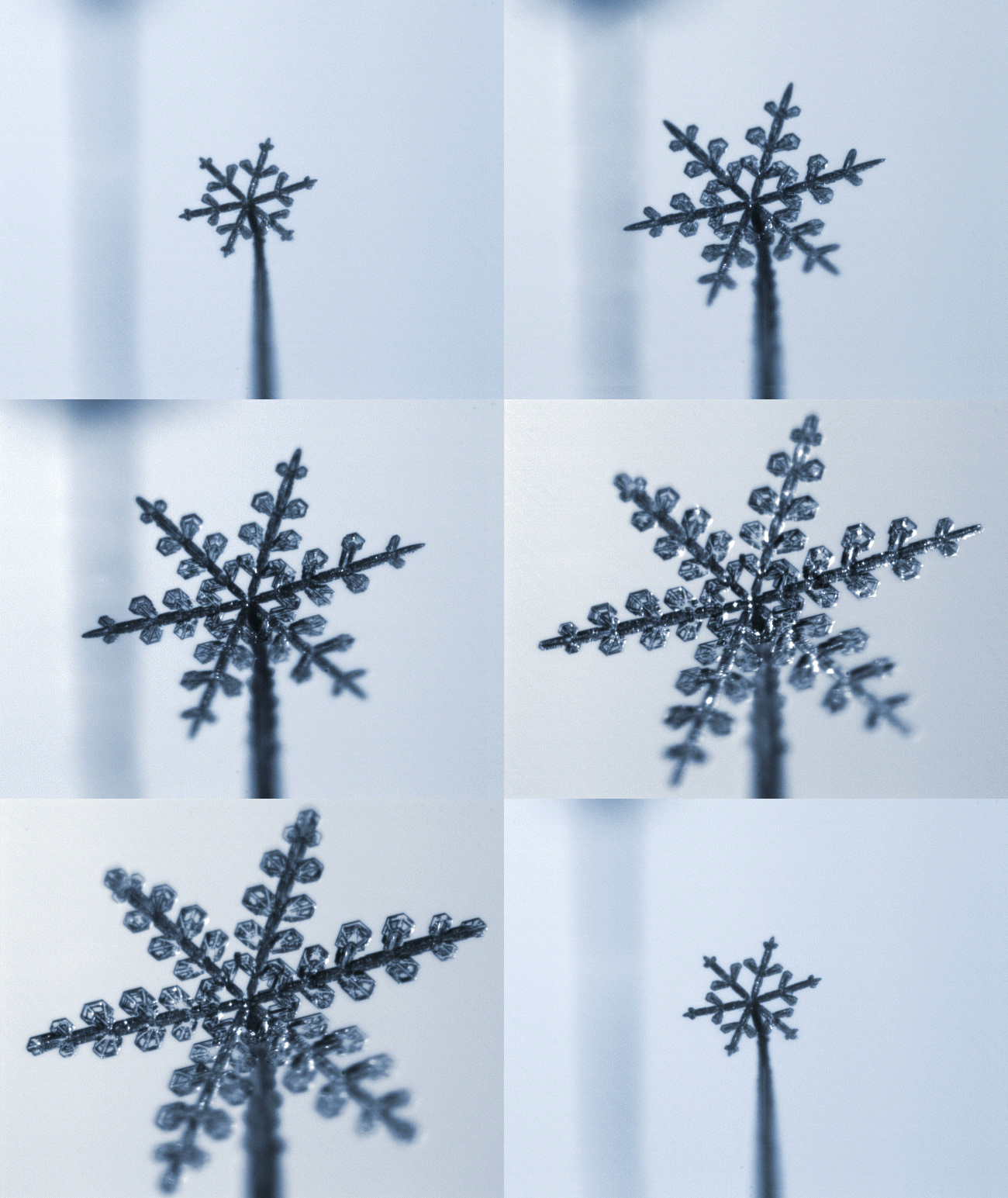
*~Snow Flakes~*

Delightful. Fascinating.
These delicate pieces of art are worth taking your time to examine and admire. Within them I find the signature of a loving and artful Creator.

Snowflakes!

We would be foolish to believe them to be simple.

The following is from Physics World:

The beautiful snowflake is much more than an attractive seasonal occurrence. In fact, understanding how a snowflake grows is a complex problem of molecular dynamics, writes Kenneth Libbrecht, Professor of Physics at the California Institute of Technology, in January’s Physics World.

Everyone knows that no two snowflakes are identical to one another. That's because they all start out as a simple hexagonal prism - the most basic form of snow crystal - but then encounter a range of atmospheric conditions as they journey down to Earth.

The conditions in the atmosphere dictate how water molecules are transported to the crystal but, because of the wide range of conditions, that makes it hard to simulate snowflake growth and explain how particular structures are formed.

Kenneth Libbrecht has said, “Beyond the intrinsic scientific questions, beyond the practical applications of crystal growth, and beyond the meteorological significance of atmospheric ice, we who ponder snowflakes are motivated by a simple and essential desire to comprehend the natural world around us.”

"How full of the creative genius is the air in which these are generated! I should hardly admire more if real stars fell and lodged on my coat."
--Henry David Thoreau
Here, in case you may not own scisorrs and paper: http://snowflakes.barkleyus.com/

Friday, November 21, 2008

Rhinotillexomania

rhino=nose, tillexis=habit of picking at something, mania=obsession with something
You can all relax now, I have found for you the very real technical name for it!
I won't go as far as to say that we all do it. That would cause great embarrassment to someone, somewhere. I will say that it's quite prevalent.
A study was conducted and published in the February 1995 issue of the Journal of Psychiatry.

One thousand surveys were mailed out, and 254 were completed and returned to the researchers.
Apparently, "91% stated that they had picked their nose in the past and were still actively practicing this habit. Yet, only 49.2% of the respondents actually thought that nose-picking was common in adults."

Here are more results:
Do it often?
9.2% rate their picking as "more than average."
25.6% actually pick their noses daily, 22.3% do it 2 to 5 times each day, and three people admitted to doing it at least hourly.

For how long?
55.5% spent 1-5 minutes, 23.5% spent 5-15 minutes, and 0.8% (2 people) spent 15-30 minutes each day cleaning their nostrils. One person reported devoting over 2 hours each day to this ritual.

Does it hurt anyone?
18% reported nosebleeds, while 0.8% claimed perforation of the nasal septum from their nose-picking.

Why do it?
82.8% had picked their noses to "unclog the nasal passages", 66.4% had done it to relieve discomfort or itchiness, 35.7% to avoid the unsightly appearance of a booger hanging from their nose, 34.0% for personal hygiene, and 17.2% picked out of habit. 2.1% (five people) claimed to pick solely for enjoyment.
How?

65.1% use their index finger, 20.2% use their pinky, and 16.4% use their thumb. WHAT!?
Most people (90.3%) disposed of the material in a tissue or a handkerchief, while 28.6% used the floor, and 7.6% stuck it to the furniture.

8% of the respondents actually ate the end product. Some reported the material as being tasty in a salty way.

There.

You can finally get this burning question off of your mind.